
Audience
Persona
We go beyond demographics to  understand who your brand is really speaking to, what
  they care about, what gets in their way,
  and what makes them choose.

01. Who Are We Actually Building This Brand For?
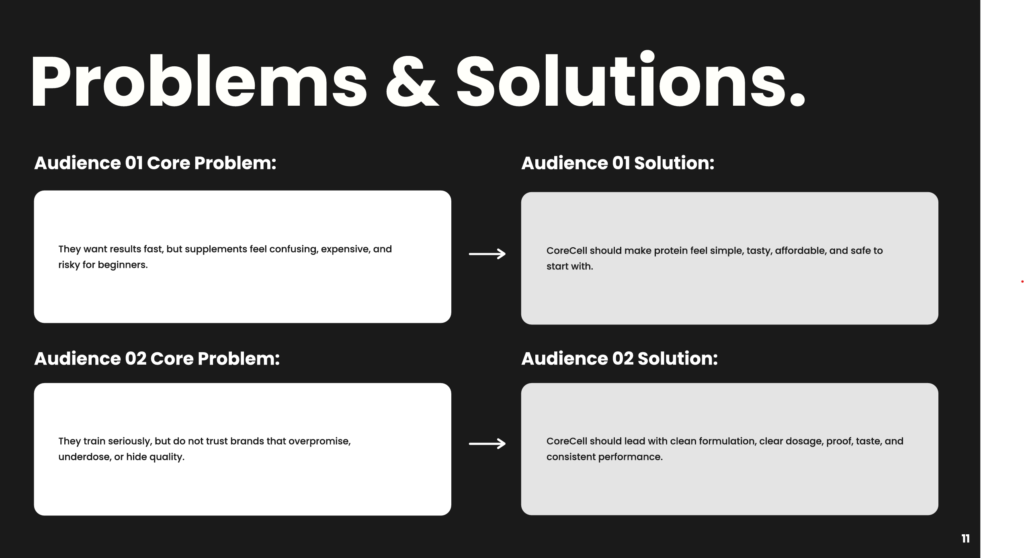
A useful audience persona goes beyond age, gender, income, and location. We look at the customer most likely to need the product, understand its value, and become relevant to the business.
We study life stage, behaviour, priorities, category relationship, and buying context to define who the brand should focus on first.
TFX Strategy in Action
For LifeRise, focusing on an audience aged 40+ changed how we approached trust, clarity, communication, and the overall feel of a doctor-led health brand.
02. What Is Your Customer Really Trying to Solve?
Customers rarely buy only for the obvious product benefit.
We look at the functional problem, emotional tension, and everyday situation behind the purchase to understand what the customer actually wants to improve, avoid, simplify, or achieve.
TFX Strategy in Action
For Uveraa, the problem was bigger than simply needing supplements. The customer needed daily nutrition to feel more personalised, understandable, and easier to stay consistent with.
03. What Makes a Customer Choose One Brand Over Another?
A buying decision is rarely based on the product alone.
Trust, convenience, price, perceived quality, ingredients, proof, packaging, familiarity, and brand perception can all influence the final choice.
We identify the strongest decision drivers so the brand knows what needs to matter first.
For Yova, the opportunity was not simply to sell makhana. The brand needed to make protein-led snacking feel modern, clean, and relevant to everyday consumption.
04. What Is Stopping Your Customer From Choosing You?
Understanding what a customer wants is only half the picture.
We also identify doubts, objections, confusion, habits, price resistance, trust gaps, and category misconceptions that may prevent the purchase.
TFX Strategy in Action
For Vedful, Ayurveda could easily feel traditional or difficult to fit into modern life. That friction helped shape a more approachable direction around Ayurveda made everyday.
05. How Should Your Brand Speak to Its Audience?
Audience persona should influence more than ad targeting.
We define what the customer needs to hear, what proof matters, how much explanation is required, which words feel natural, and what tone makes the brand feel relevant rather than forced.
For Burp, the brand did not need to communicate like another serious wellness product. A more playful audience and refreshment-led positioning allowed the voice to become lighter, simpler, and more enjoyable.
06. How Does Audience Understanding Change the Final Brand?
Audience research should eventually become visible in the brand itself.
It influences positioning, messaging hierarchy, tone of voice, visual direction, packaging communication, product claims, and which information deserves attention first.
TFX Strategy in Action
For Rinele, understanding the customer helped move the jewellery brand away from a purely traditional category expression towards something more refined, premium, and globally relevant.
Inside a TFX Audience Persona
Audience Profile
We define the customer beyond basic demographics by looking at life stage, priorities, habits, behaviour, and category relationship.
What We Map:
- Life stage
- Priorities
- Buying context
- Category behaviour
Decision Drivers
Core
We identify what actually influences the customer’s choice, from trust and value to convenience, proof, perception, and product relevance.
What We Analyse:
- Purchase triggers
- Key objections
- Trust factors
- Choice criteria
Brand Response
We turn audience understanding into clear decisions for positioning, messaging, tone of voice, visual direction, and packaging communication.
What It Shapes:
- Brand positioning
- Messaging hierarchy
- Tone of voice
- Packaging communication
Questions Founders Usually Ask
What is an audience persona in brand strategy?
An audience persona is a clear picture of the customer the brand is being built for. It goes beyond age, gender, income, or location and looks at behaviour, priorities, motivations, buying triggers, objections, and category expectations.
At TFX, the purpose is not to create a fictional customer profile for a presentation. The persona should help us make better decisions about positioning, messaging, tone of voice, identity, and packaging.
For LifeRise, understanding an audience aged 40+ meant clarity, trust, and ease of understanding became far more important than simply making the brand look modern.
How is an audience persona different from a target audience?
A target audience tells us who we want to reach. An audience persona helps us understand how that customer thinks and chooses.
For example, “urban professionals aged 25 to 40” is a target audience. But it does not tell us what creates trust, what frustrates the customer, what information matters before buying, or why one brand feels more relevant than another.
A useful persona adds that behavioural and emotional layer so the brand can communicate with much more precision.
How do you create an audience persona for a new brand with no customers yet?
A new brand does not need years of customer data before audience research can begin.
We can study the product, category behaviour, competitor audiences, market reviews, buying situations, existing research, founder knowledge, and broader customer patterns to build an informed starting point.
For Uveraa, the opportunity was not based only on demographic data. We needed to understand the frustration around fragmented supplements, confusing nutrition choices, and difficulty maintaining a consistent health routine.
The persona becomes sharper as the business gathers real customer behaviour over time.
Can a brand have more than one audience persona?
Yes, but that does not mean every audience should receive equal attention.
Many brands have a primary customer, secondary customer, buyer, user, or influencer involved in the decision. The important part is identifying which audience should drive the core positioning and communication.
Trying to speak equally to everyone usually creates vague branding.
At TFX, we prioritise the audience most important to the brand’s immediate business goal, then understand how secondary audiences fit around that core customer.
How does audience persona affect branding, messaging, and packaging?
Audience persona should influence almost every important brand decision.
It can affect:
- What benefit appears first
- Which objections need answering
- How much information packaging carries
- Whether the brand feels playful, clinical, premium, traditional, or modern
- What proof creates trust
- Which language feels natural
- What visual signals the customer understands quickly
For Burp, the audience and positioning allowed the communication to move away from serious wellness language and towards something lighter and more playful.
That is why we treat audience persona as part of Brand Strategy, not as a separate marketing exercise.
Featured Projects
Transformations Exposed
Brand Building Services Only
Not a 360° agency. A focused studio for serious brand foundations.
01
02
03
Packaging Design
Packaging designed to sell on shelves, ecommerce, and quick commerce.
04
Luxury Packaging Design
Premium packaging for brands where perception, detail, and unboxing matter.